
In this article we will describe an example of a customer engagement process you could use to help you deliver the cost assessment and FinOps as a Service offering to your customers. This can then transition into an ongoing service offering.
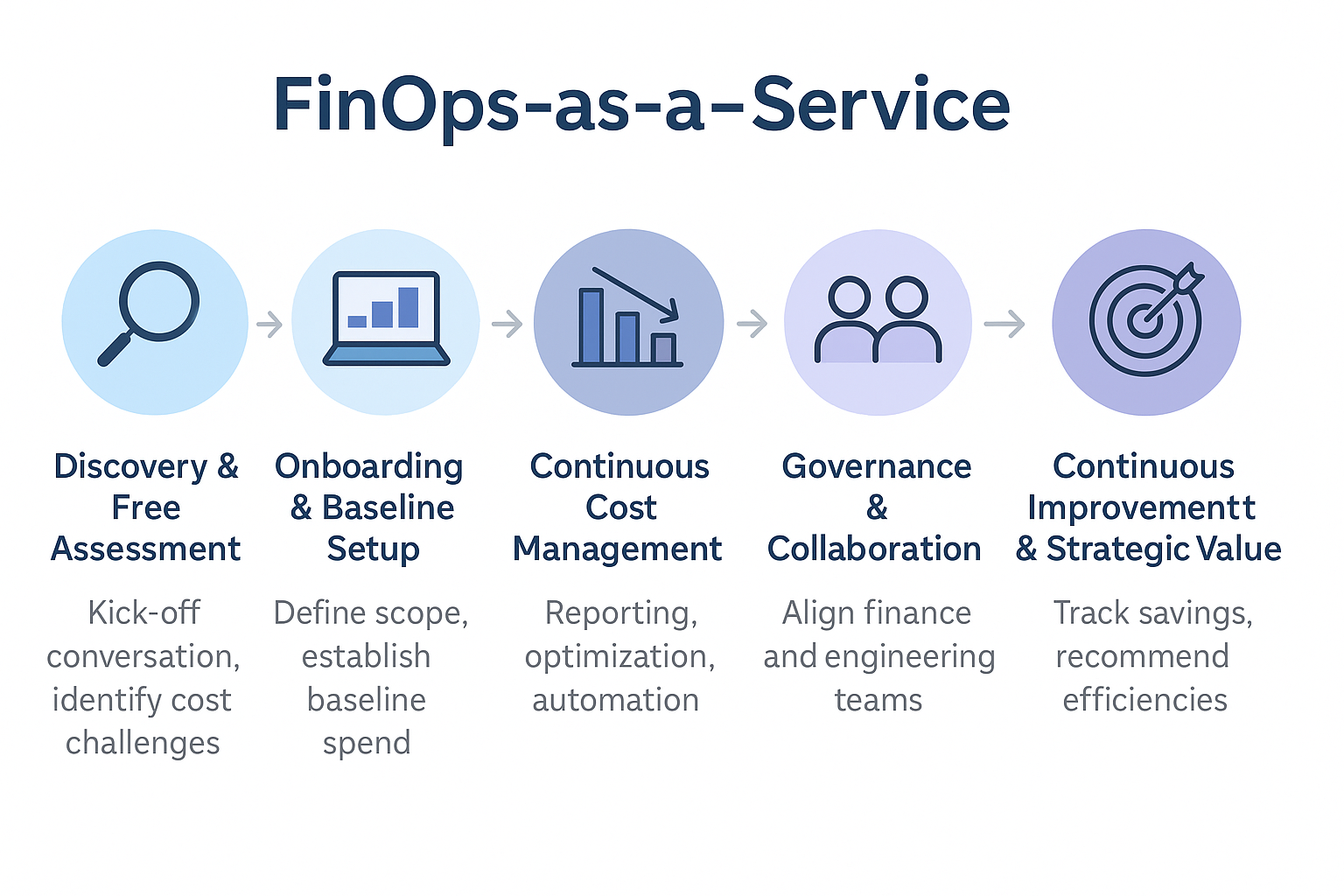
Customer Engagement Process – FinOps-as-a-Service
Step 1: Discovery & Free Assessment (Pre-Sales)
Kick-off conversation to understand the customer’s priorities, frustrations, and current cost challenges.
Free Azure Cost Assessment:
Collect current billing and usage data.
Run analysis (spend patterns, anomalies, inefficiencies).
Identify “quick win” savings opportunities.
Playback session: Present findings, highlight potential savings, and show the value of ongoing cost management.
Outcome: Build trust and demonstrate ROI to secure agreement for managed service.
Step 2: Onboarding & Baseline Setup
Sign service agreement and define scope.
Set up access (eg access to Turbo360 or other tools you might use).
Establish baseline spend, utilization, and savings targets.
Introduce governance framework (roles, responsibilities, reporting cadence).
Outcome: Shared understanding of current state and agreed goals.
Step 3: Continuous Cost Management
Ongoing activities your team delivers:
📊 Monthly Reporting & Dashboards – clear view of spend, trends, and anomalies.
🔎 Optimization Reviews – right-sizing, eliminating waste, adjusting reservations.
🤖 Automation – implement policies to scale down/off idle resources and clean up technical debt.
📉 Commitment Management – ensure Savings Plans, Reservations, and Hybrid Benefit are in place and used properly.
🛡️ Risk Monitoring – detect spikes, unusual spend, or runaway resources early.
Outcome: Predictable, optimized cloud costs with transparency for IT + Finance.
Step 4: Governance & Collaboration
Regular cadence meetings (monthly reports, quarterly reviews).
Bridge finance and engineering teams: align budgets, forecasts, and technical changes.
Provide training and awareness so both teams understand cost impacts of decisions.
Outcome: A culture of accountability where both IT and Finance own cloud costs together.
Step 5: Continuous Improvement & Strategic Value
Track actual savings achieved vs. baseline.
Benchmark customer against peers and industry best practices.
Recommend new Azure features/licensing models for additional efficiency.
Expand scope (e.g., sustainability tracking, multi-cloud FinOps, deeper automation).
Outcome: Ongoing financial confidence and proof that your MSP is protecting their money long-term.
👉 You can communicate this as:
“We start with a free assessment, move into onboarding and baseline setup, then deliver continuous cost optimization and governance with regular touchpoints. Over time, we ensure your Azure costs stay predictable, efficient, and aligned to your business goals.”